Anatomy II: The skeleton
The skeleton is the scaffold that sets proportions and shows through the skin at key points. An adult has about 206 bones, but an artist needs perhaps twenty to draw convincingly.
Bony landmarks
Wherever bone comes close to the surface it creates a hard, recognisable form: the collarbones, the point of the shoulder (acromion), the elbow (olecranon), the knuckles, the front of the pelvis (anterior superior iliac spine), the kneecap, the shin and the ankle bones. These are the points you can measure from, because they don't change with weight.
On a lean figure you can see the ribs, the spine of the shoulder blade and the seventh cervical vertebra at the base of the neck — the bump that marks where the neck meets the back.
The three big masses
Simplify the body into the skull, the ribcage and the pelvis. They are rigid; the spine connects them and lets them tilt, twist and bend against each other. Most lively poses come from these three masses pointing in different directions.
The spine is not straight: seen from the side it curves forward at the neck, back at the chest, forward at the lower back and back again at the sacrum. That double S-curve is why the back of a standing figure has rhythm.
Joints
Hinge joints (elbow, knee, fingers) bend in one plane. Ball-and-socket joints (shoulder, hip) rotate freely. The forearm has two bones, the radius and ulna; the radius rolls over the ulna to turn the palm down (pronation) and up (supination), which changes the shape of the whole forearm.
Reference table
| Bone | Where | Why it matters when drawing |
|---|---|---|
| Cranium | Skull vault | Sets the overall size and shape of the head. |
| Mandible | Jaw | The only movable bone of the skull; defines the jaw line. |
| Clavicle | Collarbone | An S-shaped strut visible at the base of the neck; it moves with the shoulder. |
| Scapula | Shoulder blade | Slides over the ribcage when the arm moves; visible on the back. |
| Sternum | Breastbone | Centre line of the chest; ribs attach to it. |
| Ribcage | 12 pairs of ribs | An egg-shaped mass, narrower at the top. |
| Vertebral column | Spine | Flexible link between ribcage and pelvis; its curves give posture. |
| Pelvis | Hips | The base of the torso; its tilt drives contrapposto. |
| Humerus | Upper arm | Head sits in the shoulder joint; elbow forms the bony point. |
| Radius and ulna | Forearm | Cross over when the hand turns palm-down. |
| Femur | Thigh | Longest bone; angles inward from hip to knee. |
| Patella | Kneecap | A floating bone that sits in front of the knee. |
| Tibia and fibula | Lower leg | The shin is the tibia's sharp front edge; the ankle bumps are their ends — inner higher than outer. |
| Calcaneus | Heel | Carries the body's weight at the back of the foot. |
Historic plates
Public-domain plates from Vesalius (1543), Leonardo's anatomical notebooks and Gray's Anatomy (1918). Tap to zoom into the detail.
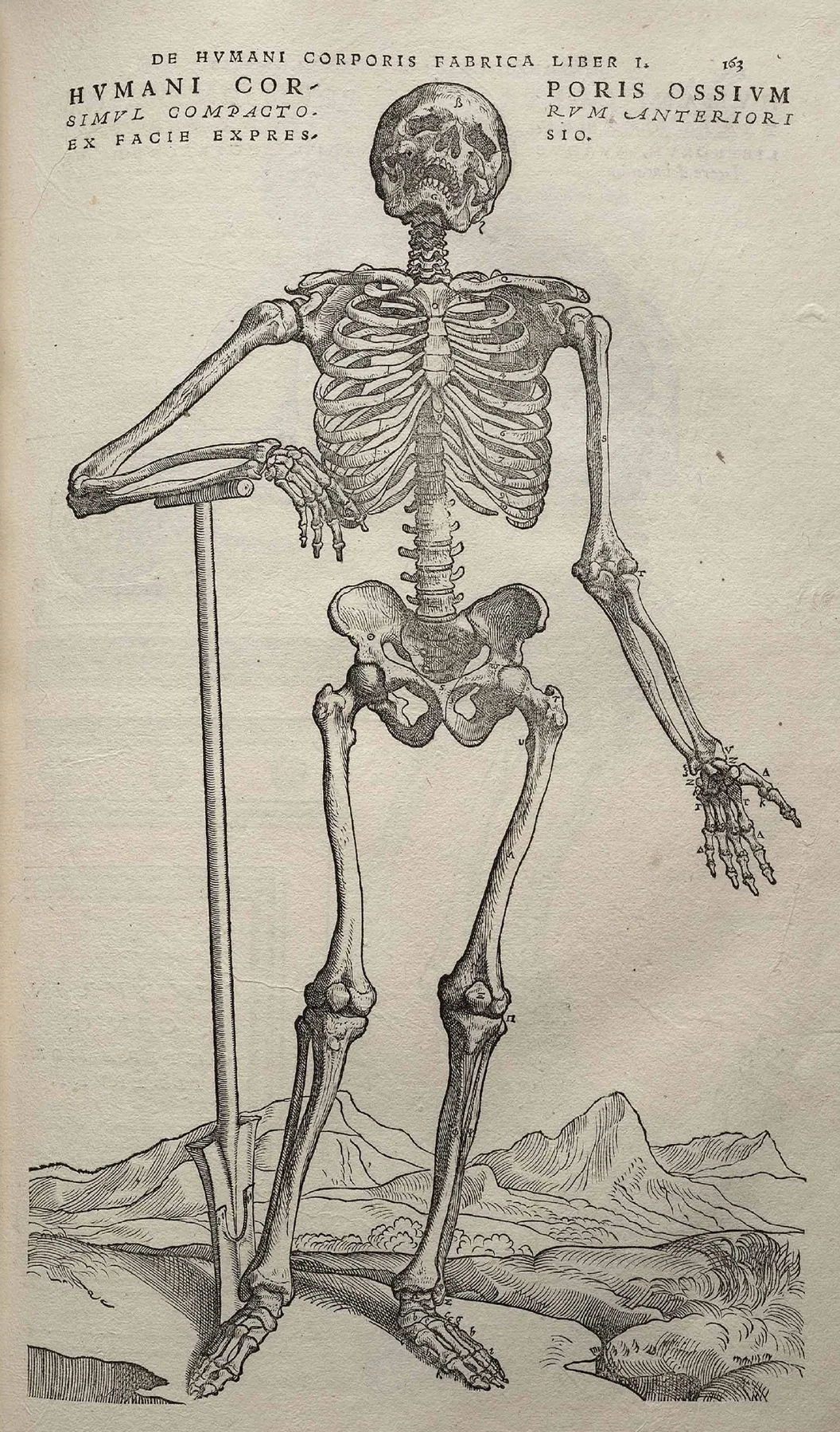
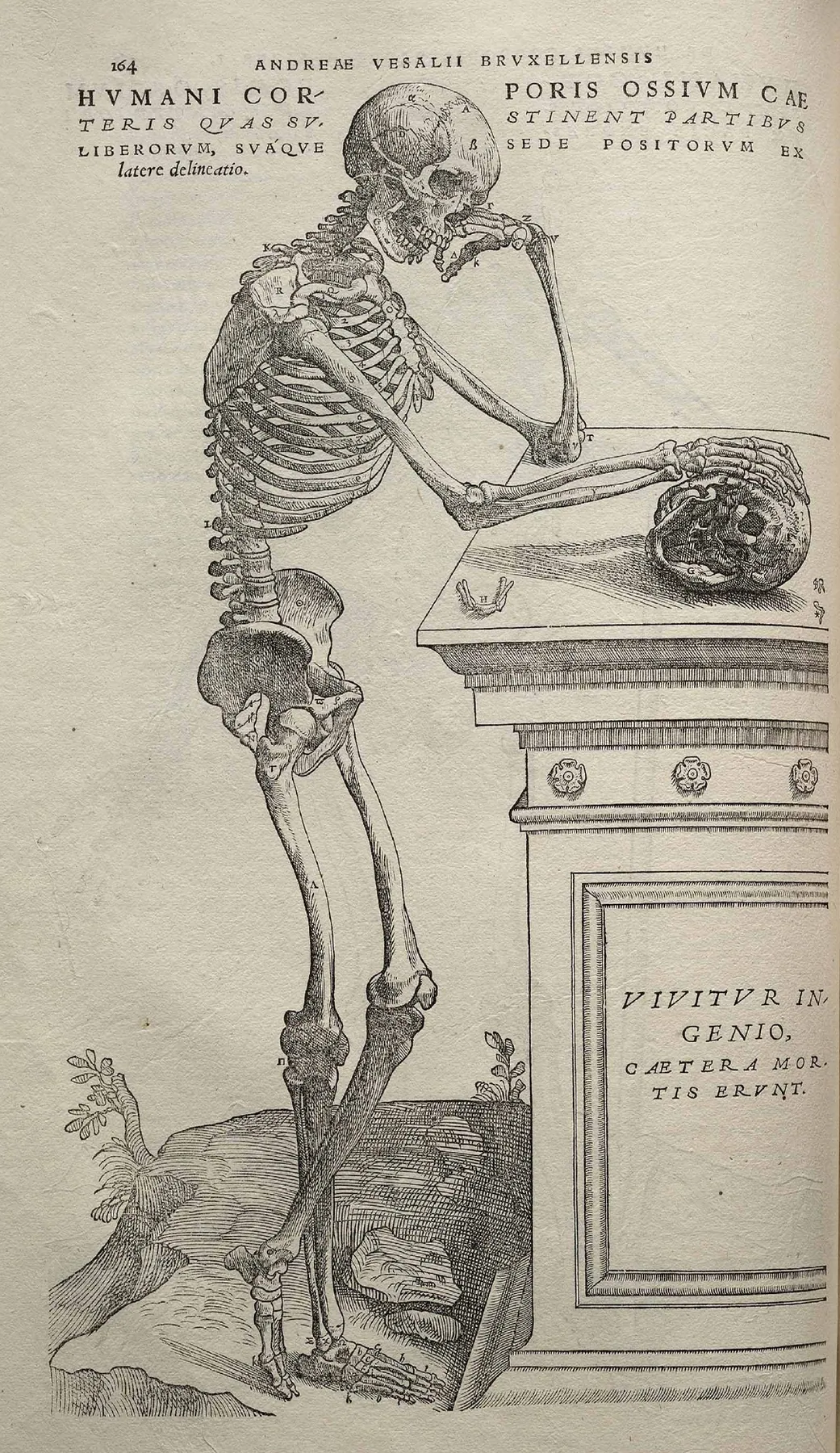
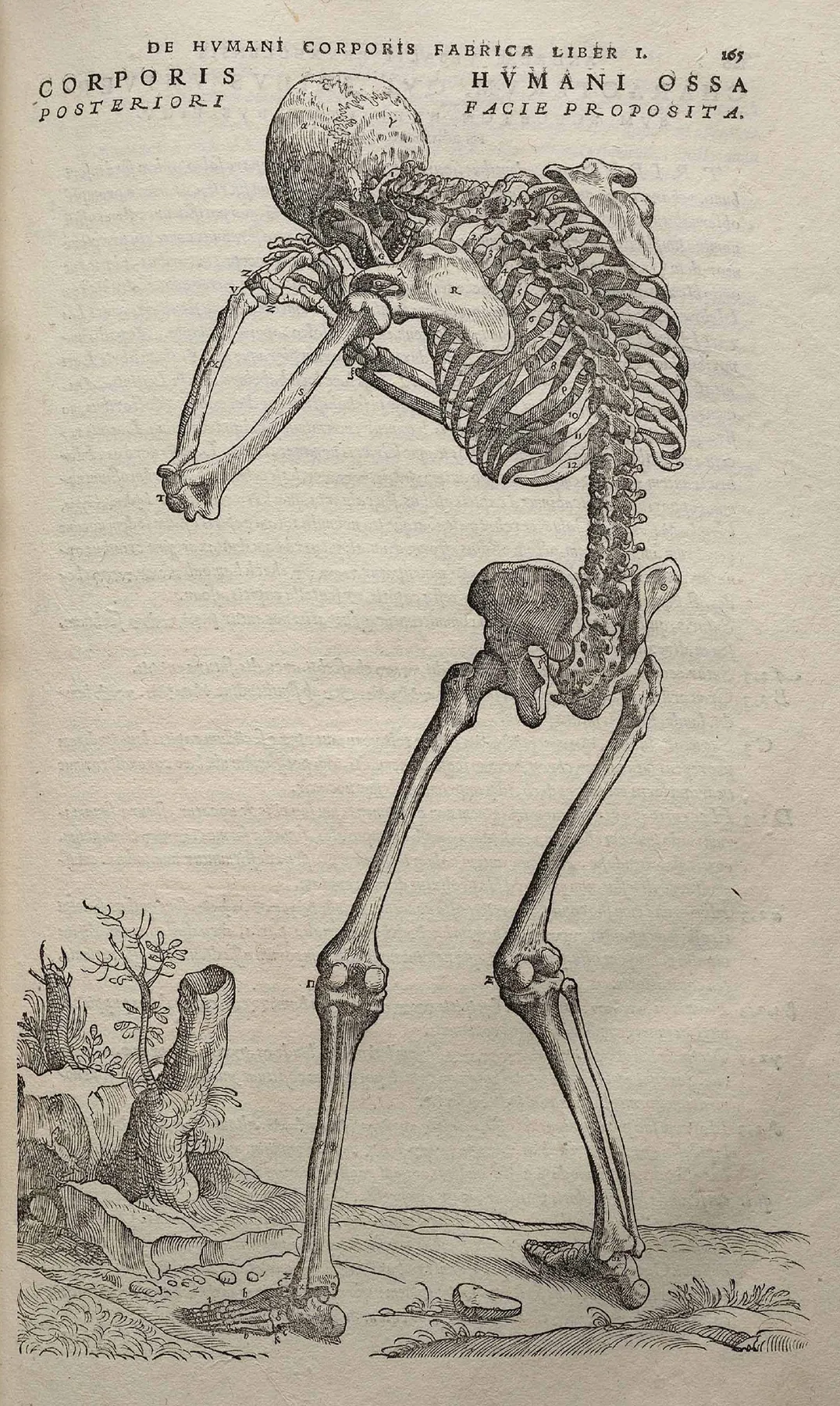
- Copy one of the Vesalius plates in 20 minutes, simplifying each bone into a basic shape.
- On a figure photo, mark every bony landmark you can see with a small cross.
Watch
Anatomy of the Shoulder Bones · Proko
The 6 Types of Joints - Human Anatomy for Artists · Proko
How to Draw the Spine - Human Anatomy for Artists · Proko
Videos load from YouTube (privacy-enhanced mode) only when you press play.